PitchTunnels gives you data-backed pitch sequencing powered by real 2024 MLB Statcast data —
the same physics that elite MLB pitchers use to dominate. Add your pitcher's arsenal, pick the
situation, and get ranked tunnel recommendations in seconds.
Free with ads · No account required
Lite $2.99/yr (ad-free) · Pro $9.99/yr (Smart Recommendations + full Pro toolkit)
Everything you need to sequence pitches like an MLB ace — built specifically for MLB The Show.
🎯
Ranked Tunnel Recommendations
Get 5+ pitch tunnel combinations ranked by effectiveness. Each recommendation explains why the pitches fool batters and when to use them.
📊
Real MLB Statcast Data
Every recommendation is grounded in 2024 MLB Statcast averages — actual velocity, horizontal break, and vertical break for all 19 pitch types. Not guesswork.
⚡
Count-Aware Strategy
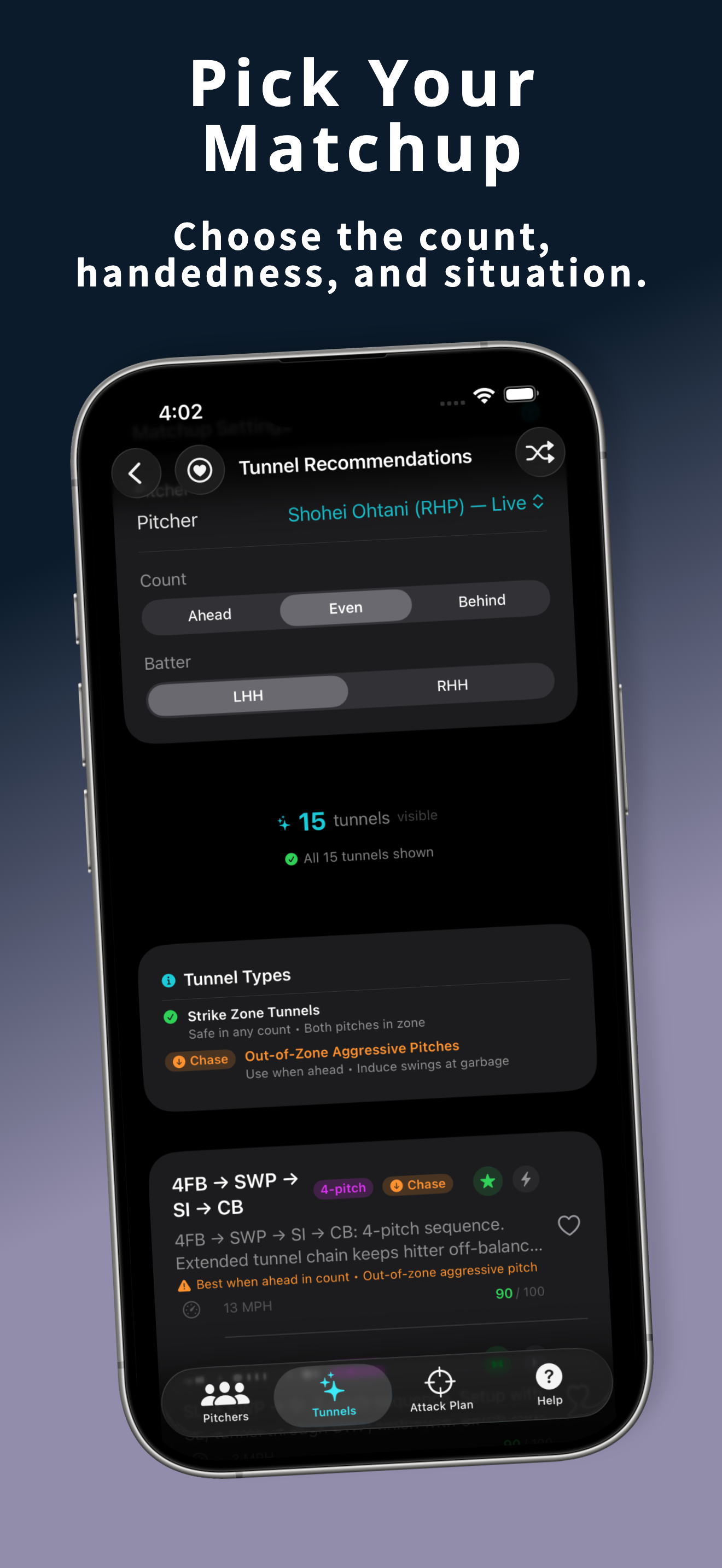
The app knows you pitch differently when ahead, even, or behind. Get chase pitch recommendations when ahead and strike-zone tunnels when behind.
🔄
Shuffle for Variety
Never throw the same sequence twice. Shuffle through different tunnel combinations to stay unpredictable across multiple at-bats and games.
❤️
Favorites Per Pitcher
Mark your best tunnels as favorites and pull them up instantly mid-game. Favorites are saved per pitcher so your arsenal stays organized.
🎬
Attack Plan — At-Bat Sequencing
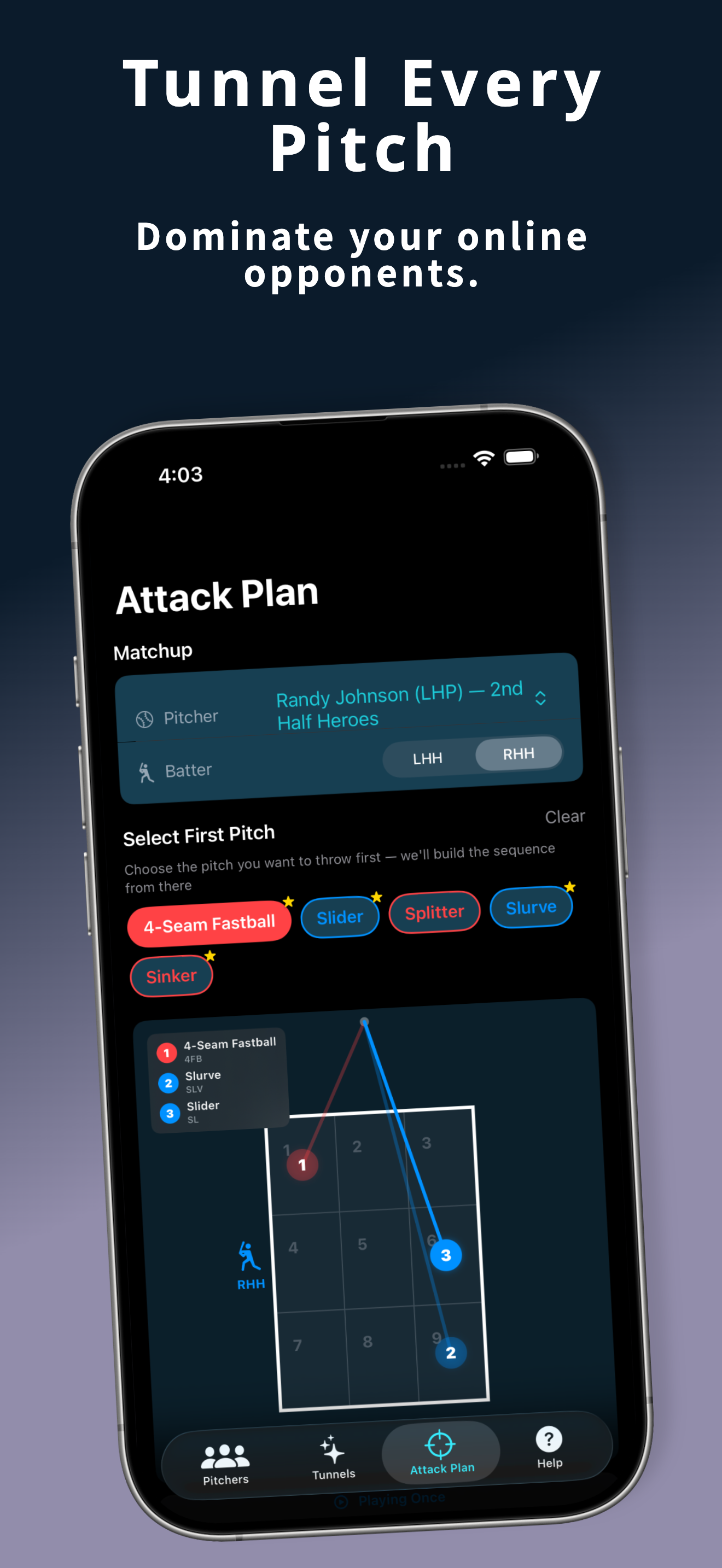
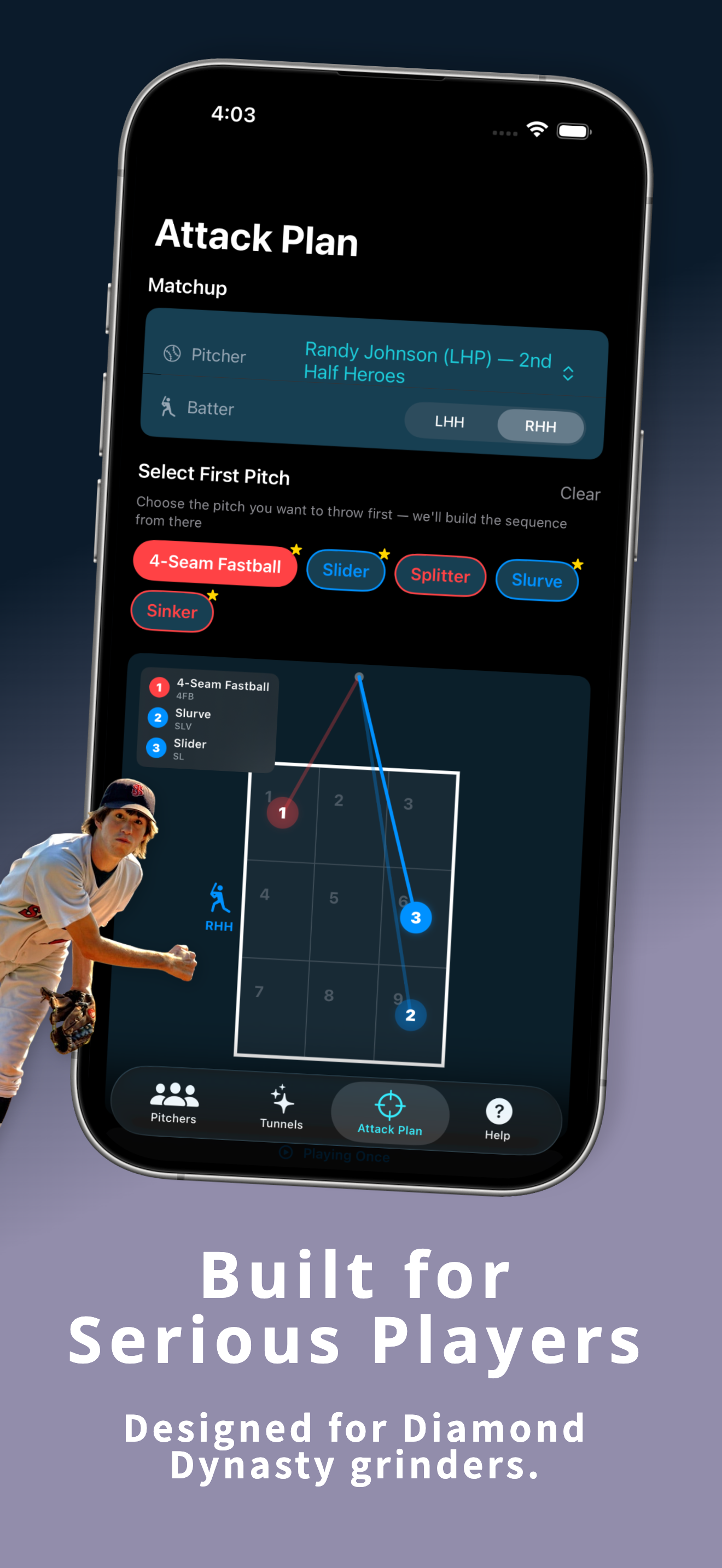
Pick your first pitch and the app builds a full 3-pitch sequence around it. The strike zone auto-loops through each pitch with a live animated ball path — or freeze it to study all three at once. Gold stars highlight the best opening pitches. Adjust loop speed from Slow to Fast.
🧠
Smart Recommendations PRO
Tunnels ranked for the card actually in your hand — weighing its attributes, the batter's handedness, and where each pitch type sits in the current MLB The Show 26 meta. Tunnel Breakdown shows the movement plot and the numbers behind every ranking.
⚾
Manage Your Staff PRO
Set your real Rotation and Bullpen with Active Roster, then let Situation Finder answer "who do I bring in?" for any spot in the game. Bear Down Advisor tells you when to spend a charge and what to throw.
🎯
Pitch Sequencer PRO
Walk a live at-bat pitch by pitch, with the count, instead of planning three pitches up front. Pairs with Pitch Power Ranking, which scores your whole arsenal best to worst.
🔒
100% Offline
No account, no internet required. Everything runs locally on your device — add pitchers, generate tunnels, use the app anywhere.
How It Works
Two powerful modes — pick the one that fits your situation.
1
Build Your Pitcher
Add any pitcher from your MLB The Show roster. Enter their name, handedness, and select pitches from their arsenal. Optionally set custom MPH for each pitch to match their exact in-game ratings. That's it — your pitcher is ready.
2
Set the Matchup
Choose your pitcher, set the count situation (ahead / even / behind), and select the batter's handedness. The count matters — PitchTunnels filters recommendations based on whether you should be expanding the zone or throwing strikes.
3
Get Ranked Tunnel Recommendations
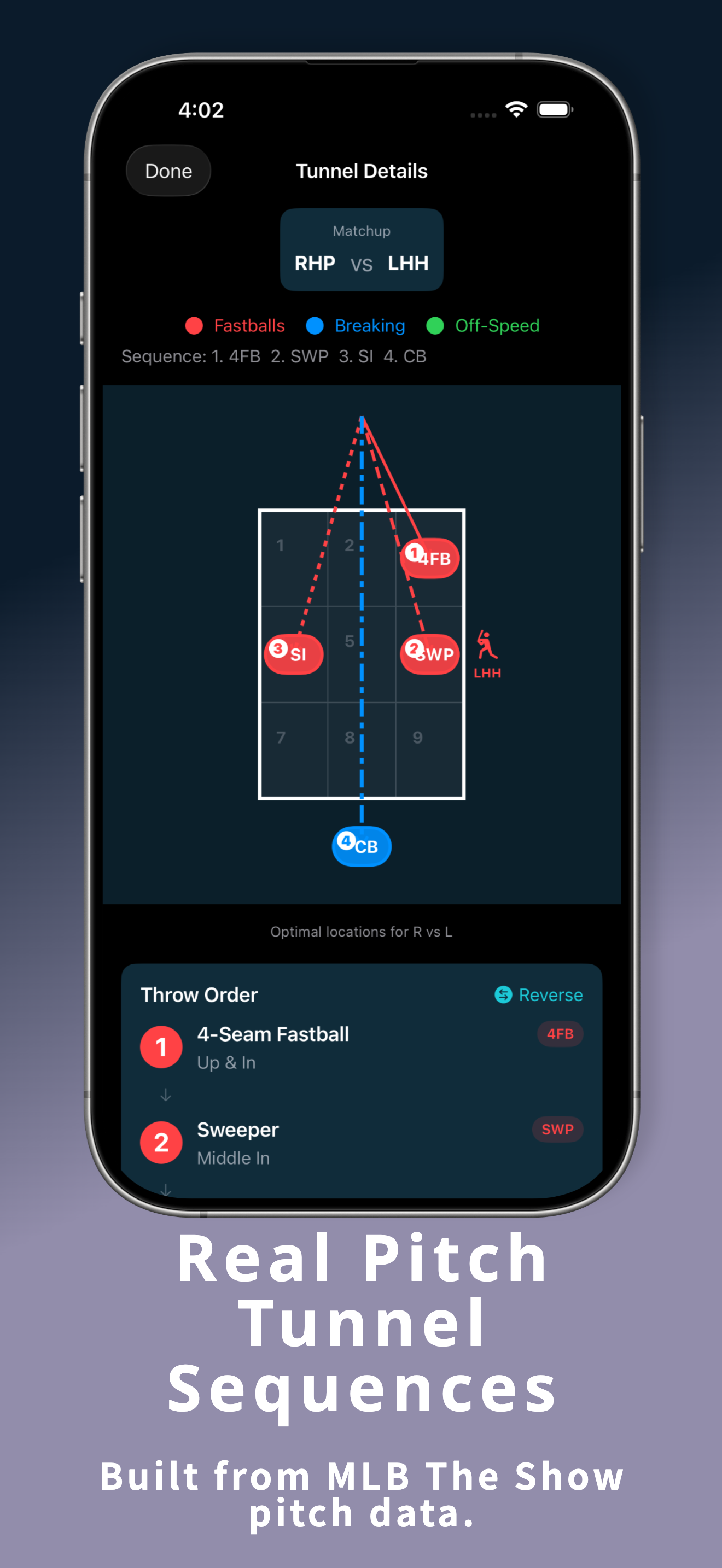
See 5+ pitch tunnel pairs ranked by effectiveness with quality scores (1–100), velocity differentials, and the science behind why each combination works. Tap any tunnel to see the visual strike zone diagram showing both pitch paths.
⚡
Or: Build an Attack Plan
Switch to Attack Plan mode to design a full 3-pitch at-bat sequence. Gold stars on the pitch chips highlight your best opening options. Pick your first pitch — the app builds the optimal follow-up pitches using tunneling science. The animated strike zone automatically loops through all three pitches, drawing each ball path in real time. Freeze it to Static View to study all paths at once, or dial in the playback speed — Slow, Normal, or Fast. The perfect tool for pre-loading a game plan before a big at-bat.
Screenshots
PitchTunnels v1.3 — available now on the App Store. Updated June 2026. Screenshots shown on iPhone. PitchTunnels runs natively on iPhone and iPad.
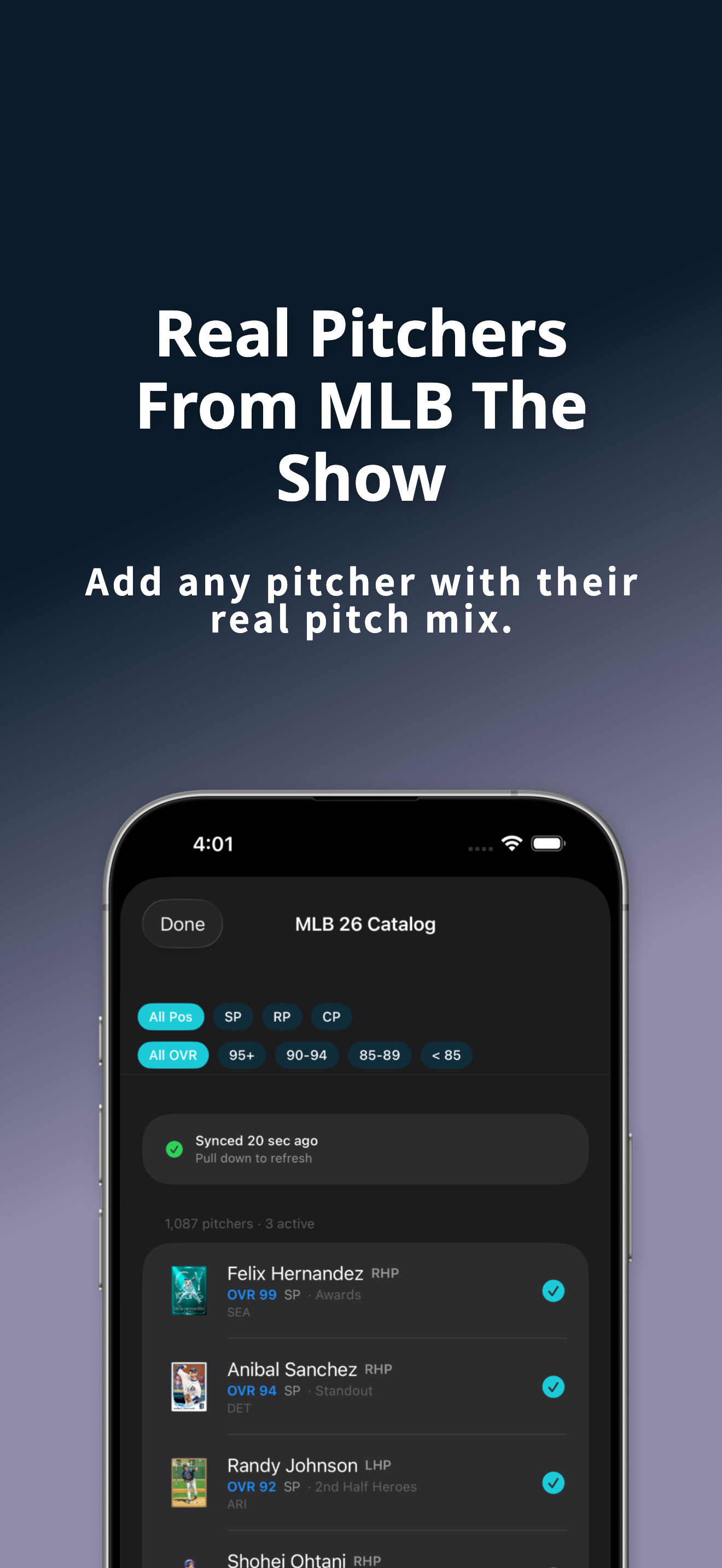
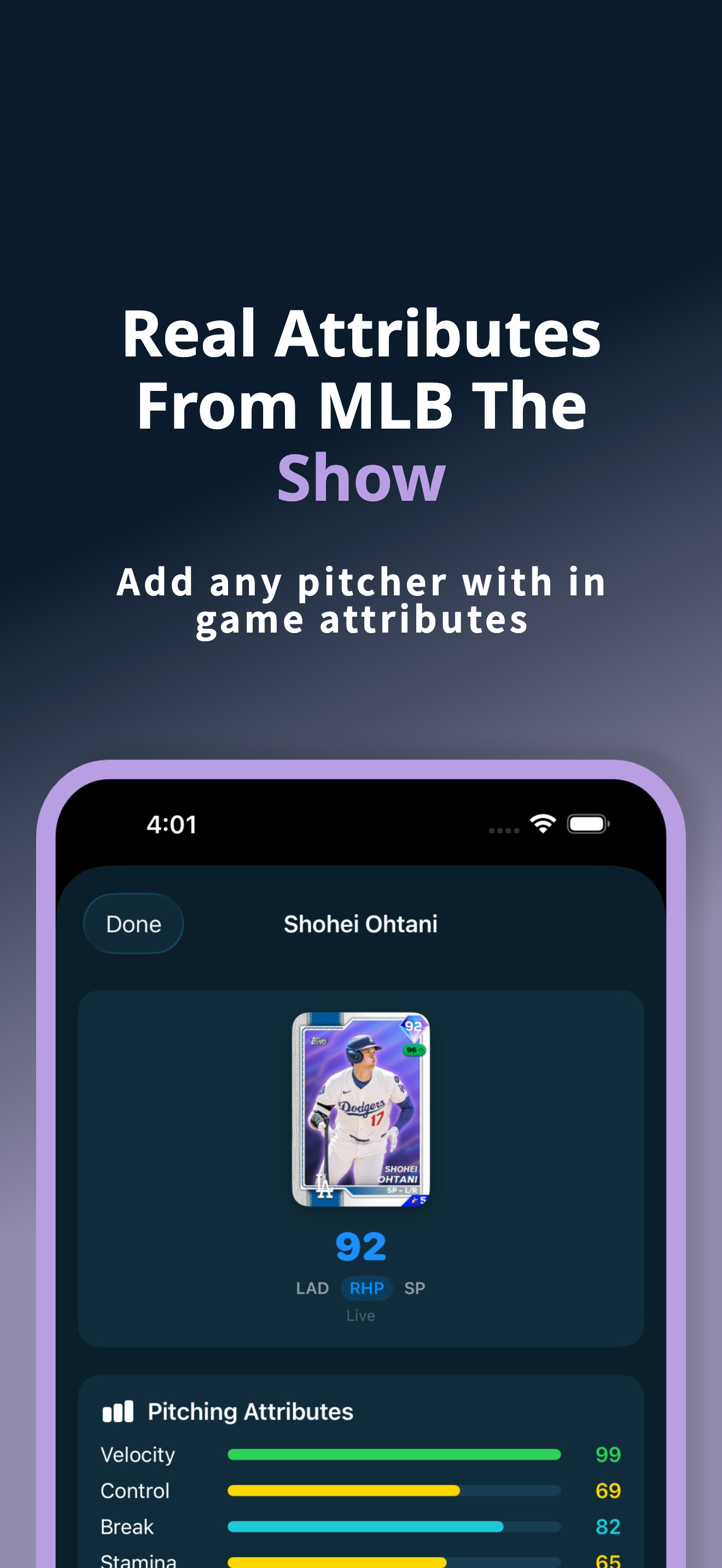
Attack Plan — animated 3-pitch at-bat sequencesMLB 26 Pitcher Catalog — 1,000+ roster pitchers with card artPitcher details with real in-game attributesTunnel recommendations — ranked by effectivenessYour pitchers — unlimited custom arsenalsVisual strike zone with pitch paths
See It In Action
Watch the full walkthrough — what pitch tunneling is, how the app works, and a live demo.
The Science Behind It
Pitch tunneling is real physics used by elite MLB pitchers. PitchTunnels applies that science to MLB The Show.
Key Numbers
Tunnel Point23.8 ft from plate
Decision Window~175 ms before contact
Pitch Types Modeled18 all MLB The Show pitches
Data SourceMLB Statcast 2024 season
At 23.8 feet from the plate, a hitter has roughly 175 milliseconds to make a swing decision.
If two pitches look identical at that point, the batter can't distinguish them — no matter how experienced they are.
This is the tunnel point, and it's the foundation of PitchTunnels's entire recommendation engine.
How Tunnel Scores Work
Each tunnel pair gets two scores (1–10) multiplied together:
🎯
Tunnel Quality
How similar the pitches look before the decision point — based on arm action group compatibility. Same arm slot = better tunnel.
↔️
Separation Quality
How far apart the pitches end up at the plate in inches (Euclidean distance from Statcast HB + IVB data), plus a velocity timing bonus.
Total Score = Tunnel Quality × Separation Quality 90+ = Elite · 70+ = High · 40–69 = Viable
Featured Tunnel Data
Real 2024 MLB Statcast plate separation data — these numbers explain why some tunnels dominate while others disappoint.
Pitch Pair
Plate Separation
Velo Gap
Why It Works
Score
Sinker + Sweeper
~33"
10+ mph
Opposite arm-side break — 33" horizontal gap at the plate. Both pitches look identical out of the hand.
90
4-Seam + Sweeper
~28.6"
11+ mph
Opposite horizontal break plus velocity. The biggest physical contrast a fastball can offer.
Both run arm-side — this is a velocity tunnel, not movement. Works through timing only.
45
Cutter + Slider
~8.5"
2 mph
Very similar arm action, small velocity gap. Often overrated — batters can track both pitches.
24
Sinker + Circle Change
~2.1"
9 mph
Both move almost identically arm-side. Nearly zero plate separation — velocity is the only deception.
27
* Plate separation is the Euclidean distance in inches using real 2024 MLB Statcast horizontal break (HB) and induced vertical break (IVB) averages. RHP perspective shown.
Key Insights
What the Statcast data reveals — some of it will surprise you.
↔️
Opposite Break = Maximum Deception
Sinker + sweeper creates 33" of horizontal separation at the plate — the largest gap of any common pair. Both pitches leave the hand identically. Hitters cannot distinguish them before the tunnel point.
⚡
Velocity Gap = Timing Deception
A 10+ mph gap between pitches with identical arm action (like 4-seam + changeup) forces batters to commit before knowing pitch speed. This is velocity tunneling, and it's devastatingly effective.
📐
Changeup Actually Rises (Relative)
Real Statcast data shows changeups have +7" induced vertical break — they don't "drop." Their perceived drop is relative to the 4-seam's +16.5" rise. The timing mismatch is the deception, not gravity.
⚠️
Same-Direction Pairs Disappoint
Sinker + circle changeup both move arm-side and end up only 2.1" apart at the plate. This pair is almost entirely a velocity tunnel. Cutter + slider has 8.5" separation and a 2 mph gap — barely a tunnel.
🌀
Sweeper Is the Secret Weapon
The sweeper's extreme glove-side break (−17") pairs with any arm-side pitch for maximum horizontal separation. This explains why elite MLB pitchers with sweepers post historically dominant strikeout rates.
🎯
Sinker-First Strategy
Research shows sinkers are premier setup pitches in MLB The Show. When your pitcher has a sinker, PitchTunnels automatically prioritizes sinker tunnels — mirroring real MLB strategy from pitchers like Corbin Burnes.
Research-Backed, Not Guesswork
PitchTunnels's recommendations draw from three sources — all of them real.
📊
Primary Source
MLB Statcast (Baseball Savant)
2024 season averages across all MLB pitchers. Actual velocity, horizontal break (inches), and induced vertical break (inches) for every pitch type — the same data analysts use.
🎮
Validation
MLB The Show 26 Live Testing
Tunnel recommendations are validated through real game sessions across all handedness matchups. Pitch behavior and location effectiveness tested to ensure real-world accuracy in the game.
🔬
Foundation
Pitch Tunneling Science
Based on published pitch tunneling research including tunnel point theory — 23.8 feet from the plate, the last moment a hitter can change their swing decision (~175ms before contact).
Pick Your Tier
The core tunnel engine is free — upgrade to remove ads or unlock the full Pro toolkit.
Free
$0
All features with ads
Unlimited custom pitchers
All tunnel recommendations
Chase pitch tunnels
Shuffle for variety
MLB 26 Pitcher Catalog
Favorite tunnel analytics
Pitch Guide — every pitch type ranked by meta tier
Scouting tags & handedness edge on any card
Works 100% offline
Lite
$2.99/yr
Ad-free experience
Everything in Free
No ads (banner + interstitial removed)
Works 100% offline
Pro
$9.99/yr
Full power, no ads
Everything in Lite
Smart Recommendations — tunnels ranked for your exact pitcher, matchup & the live meta
Bear Down Advisor — when to spend a charge and what to throw
Pitch Sequencer — walk a live at-bat, pitch by pitch
Situation Finder — ranks your bullpen for any spot
Active Roster — set your real Rotation and Bullpen
Pitch Power Ranking — your arsenal scored best to worst
Cancel anytime in Settings → Apple ID → Subscriptions
Frequently Asked Questions
Pitch tunneling is when two pitches follow the same path out of the pitcher's hand before diverging late — after the batter's decision point. The batter commits to a swing (or no-swing) based on what they see at the tunnel point. If both pitches look identical there but arrive in completely different locations, the batter is stuck guessing.
Yes. You add any pitcher and select pitches from their arsenal. You can add custom MPH for each pitch to match their in-game ratings. PitchTunnels generates recommendations based on the specific pitches in that pitcher's arsenal — so a pitcher with only 3 pitches gets different (and more focused) recommendations than one with 6.
Real Statcast data reveals surprises. Sinker + circle changeup — widely considered a great pair — ends up only 2.1" apart at the plate because both break heavily arm-side. Cutter + slider has 8.5" separation and a 2 mph gap, making it barely a tunnel at all. The scores reflect physics, not conventional wisdom.
No account required. PitchTunnels has three tiers: Free (all features with ads), Lite ($2.99/year, ad-free), and Pro ($9.99/year, adds Smart Recommendations, Bear Down Advisor, Pitch Sequencer, Situation Finder, Active Roster, Attack Plan and Pitch Locator, ad-free). Everything runs 100% offline on your iPhone or iPad — your pitcher data stays on your device, never transmitted anywhere.
Each tunnel is rated High (⭐⭐⭐), Medium (⭐⭐), or Low (⭐) based on its quality score. The score (1–100) multiplies Tunnel Quality (arm action similarity) × Separation Quality (plate separation in inches + velocity bonus). A score of 90 is elite. 70+ is high. 40–69 is viable. Low-rated tunnels still work — save them for when opponents have adjusted to your main sequences.
Attack Plan is a 3-pitch at-bat sequencer. Instead of picking a tunnel pair, you choose the first pitch you want to throw. The app builds the optimal 2nd and 3rd pitch around it — each chosen to tunnel off the pitch before it. Gold stars on the pitch chips highlight the best opening pitches from your arsenal.
The strike zone auto-loops through all three pitches with animated ball paths, so you can study the full sequence before you play. Tap Auto-Playing to pause and see all paths at once in Static View. Use the Slow / Normal / Fast speed picker to control playback pace. It's the same tunneling science as the Tunnels tab, packaged as a game plan you can load before the at-bat.
Yes. When the zone is in Auto-Playing mode, a Slow / Normal / Fast speed picker appears next to the loop button. Slow gives you long pauses to study each pitch. Normal is the default. Fast cycles quickly for a rapid recap when you already know the sequence.
You can also tap Auto-Playing to freeze the zone in Static View — all three pitch paths appear at once so you can study the complete plan without any timing pressure. Tap Static View to resume the loop. Turn off all ball-travel animation entirely in Help & Settings → Attack Plan → Pitch Path Animations.
Yes. 100% offline. No account, no internet connection, no data collection. Everything runs locally on your device. You can open the app mid-game and use it without pausing or connecting to anything.
Everything — unlimited pitchers, all tunnel recommendations, chase pitch tunnels, shuffle, the full MLB 26 Pitcher Catalog, and favorite tunnel analytics. The Free tier is ad-supported (banner + interstitial ads). Upgrade to Lite ($2.99/year) to remove ads, or Pro ($9.99/year) to also unlock Smart Recommendations, Bear Down Advisor, Pitch Sequencer, Situation Finder, Active Roster, Pitch Power Ranking, Tunnel Breakdown, Attack Plan and Pitch Locator.
Yes. PitchTunnels is built for MLB The Show 26 using real 2024 MLB Statcast data. Pitch physics and tunnel mechanics are validated against in-game behavior.
Research across all 4 handedness matchups consistently shows a sinker placed mid-low inside — not the bottom corner, but mid-low — is the single most effective tunnel setup pitch in MLB The Show. The app's algorithm automatically prioritizes sinker-based tunnels when your pitcher has one, mirroring what elite MLB pitchers like Corbin Burnes do in real life.
Yes. Your roster is saved locally on your device and persists between sessions. Everything stays on your iPhone or iPad, never transmitted anywhere.
PitchTunnels v1.3 is available now on the App Store. Download it here — free with ads, or upgrade to Lite ($2.99/year) or Pro ($9.99/year). Questions? Email support@retroghostlabs.com.
Also by RetroGhostLabs
More tools for competitive MLB The Show players.
PitchGuessr
Track your opponent's pitching patterns pitch-by-pitch and predict where they'll throw next. Builds a live heatmap during each at-bat — free with ads, unlimited tracking on all tiers. Lite $2.99/yr, Pro $9.99/yr with Zone Splits, Strike Rate Panel, and iCloud sync.